The brutal math of failure
Most published estimates put the first-attempt pass rate for prop-firm challenges somewhere around ten to fifteen percent. That number is worth sitting with for a moment. It means somewhere around 85 of every 100 traders who pay for a challenge fail the first time. Most fail the second time too. The math is brutal but it isn't a verdict — it's the baseline rate against which every individual attempt is measured.
Here are the receipts of what mine looked like before any of this worked:
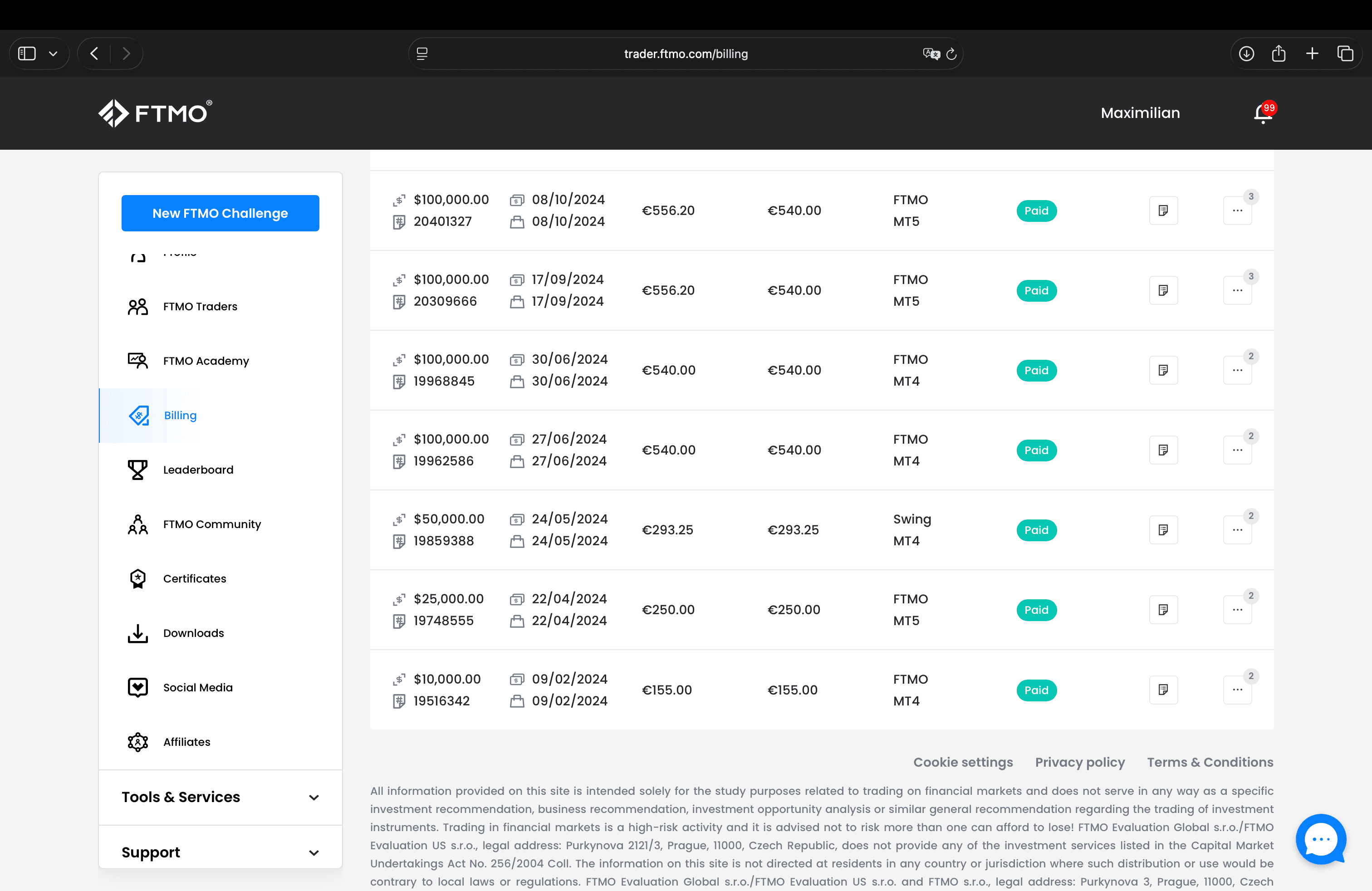
I lost more challenges than I'd like to count before I figured out what actually works. Then I passed FTMO Verification four times and reached Platinum tier. The certs are on the homepage. So is the payout-screen. I am telling you the failure-side first because every guide on the first page of Google buries it or skips it entirely.
The seven days you do not trade
The single highest-failure-mode I see in traders who blow a challenge is paying for the next one inside 48 hours. Angry money compounds. You retake to "prove" something to yourself, the market hands you the same lesson it just handed you, and your account dies the same death. The first rule after a blown challenge is: stop trading for seven days. No charts, no demo, no "just one" setup. The seven days are not for resting. They are for doing the work I describe in the next section while the trades that killed you are still fresh enough to diagnose.
The five-question failure audit
Before you touch a chart again, answer these five questions in writing. Pen and paper, not memory.
- What rule killed you? Daily-loss-limit, max-drawdown, news-trading, consistency, or time. Be specific about which one, because each implies a different fix.
- Was it position-sizing or strategy? If you would have breached the rule even with a smaller position, your strategy needs rework. If a smaller position would have survived, your strategy is fine — your sizing is the problem.
- Was it execution or psychology? If you knew the rule and broke it anyway, the issue is psychology. If you didn't fully understand the rule before you started, the issue is education.
- Was it one trade or accumulated? One catastrophic trade points to a revenge-trade pattern or a setup outside your edge. Accumulated drawdown points to total exposure being too high across the day or week.
- Would you do the exact same trades again? If yes, your system has an unfixed flaw. If no, your discipline broke at a specific moment. Both have fixes — but they aren't the same fix.
Most traders skip this audit because it feels like rubbing salt in the wound. It isn't. It's the only way to make sure the next attempt looks measurably different from the one that just ended.
What I changed when nothing else worked
After my own audits, the single biggest shift wasn't a new strategy. It was a new architecture for the same strategy. I built the system around three principles that I now use on every funded account:
- Asymmetric risk architecture. Stop trying to win bigger. Start losing smaller. The expected-value math works for you when your worst day is half of what it used to be — even if your best day is the same.
- Edge validation protocol. Know your win-rate and R-multiple before you trade live. If you can't cite both numbers from at least 100 backtested trades on the exact challenge ruleset, you don't have an edge yet — you have a hypothesis.
- Execution discipline loop. Most failures don't happen at the trade. They happen in the minutes before and after, when you decide whether to obey your own rules. The loop is what you do at those moments. It's not glamorous and it's the part that matters most.
Retake, switch firms, or quit — the decision tree
Once the audit is done and the seven-day cool-off is over, you have three real options. Most traders pretend they only have two.
Quit if you are trading on borrowed money, you have no demo track-record on the exact ruleset, or you cannot afford another challenge fee without affecting rent or food. None of those are weakness signals. They are honesty signals.
Retake at the same firm if the audit produced a clear diagnosis, you have completed at least seven days of cool-off, and you can write down — in one paragraph — what you are doing differently. "I'll be more disciplined" is not a paragraph. "I'll cap daily loss at half of FTMO's limit and use a journal-mandate before every trade" is.
Switch firms only if you have failed three challenges at the same firm with the same setup and the audit reveals the firm's specific rules clash with your style. Switching is not a fresh start. Most failure patterns travel with the trader, not the firm.
What I would do if I had to start again from zero
If everything I learned were taken away tomorrow and I had to pass my first challenge again from scratch, this is the path I would take — in order, no skipping:
- Thirty days of demo trading on the exact ruleset of the firm I plan to attempt. Not a generic demo. The exact rules. Otherwise the constraint that will eventually kill me never gets practiced.
- One hundred backtested trades minimum on a single strategy I can explain in three sentences. If I can't explain it in three, I don't actually have one.
- A position-sizing lock at 0.5 to 1 percent risk per trade for the first month. Two percent comes later, after the sizing has been proven on a real account.
- A self-imposed daily-loss-cap at half of whatever the firm allows. Auto-discipline built into the rules I refuse to break, not into my willpower in the moment.
- Weekly accountability with one other person. Not a course or a Discord. One person who will ask "did you follow your rules this week" and who I cannot lie to without it being obvious.
That is not a fast path. It is not the path the affiliate-blogs sell you. But it is the path that took me from blowing challenges to Platinum tier, and it is the same architecture I now coach traders through inside the system on this site.
One last thing
If you just blew a challenge, the most useful thing you can do today is nothing. Close the broker. Close the prop-firm dashboard. Open a notebook. Start the audit. The next challenge can wait. Trading rewards traders who can wait. It punishes the rest.
Past performance — mine or anyone else's — does not guarantee future results. The numbers and certs on this site reflect what I have done. They are not a promise of what you will do. The system can shorten the curve. It cannot eliminate the work.
If this post was useful and you want the full version of the system — including the position-sizing rules, the edge-validation worksheet, and one-on-one coaching while you run the next challenge — that's on the homepage under MB Capitals. If you'd rather just message me first, WhatsApp is open.
Frequently asked questions

Author
Maximilian Bossow
Independent prop-firm trader. Reached FTMO Platinum tier with verifiable Overall Rewards across multiple funded accounts. Founder of MB Capitals — a coaching system for traders who want to pass prop-firm challenges through structured risk management, not gurus. The proof is on the homepage: every cert, every payout, every receipt of what it took to get there.