Pillar 01
Risk first. Trade second.
Your max loss is decided before the chart opens. Even ten losses in a row can’t take you out — the math protects you on bad days.
5 rules. Inside the Blueprint.
The receipts, the method, and why I only work with applicants who take steps.
Pass the challenge · Keep the funding · I take on a handful at a time
Educational·Not investment advice·Past performance ≠ future results
Platforms & prop firms I trade
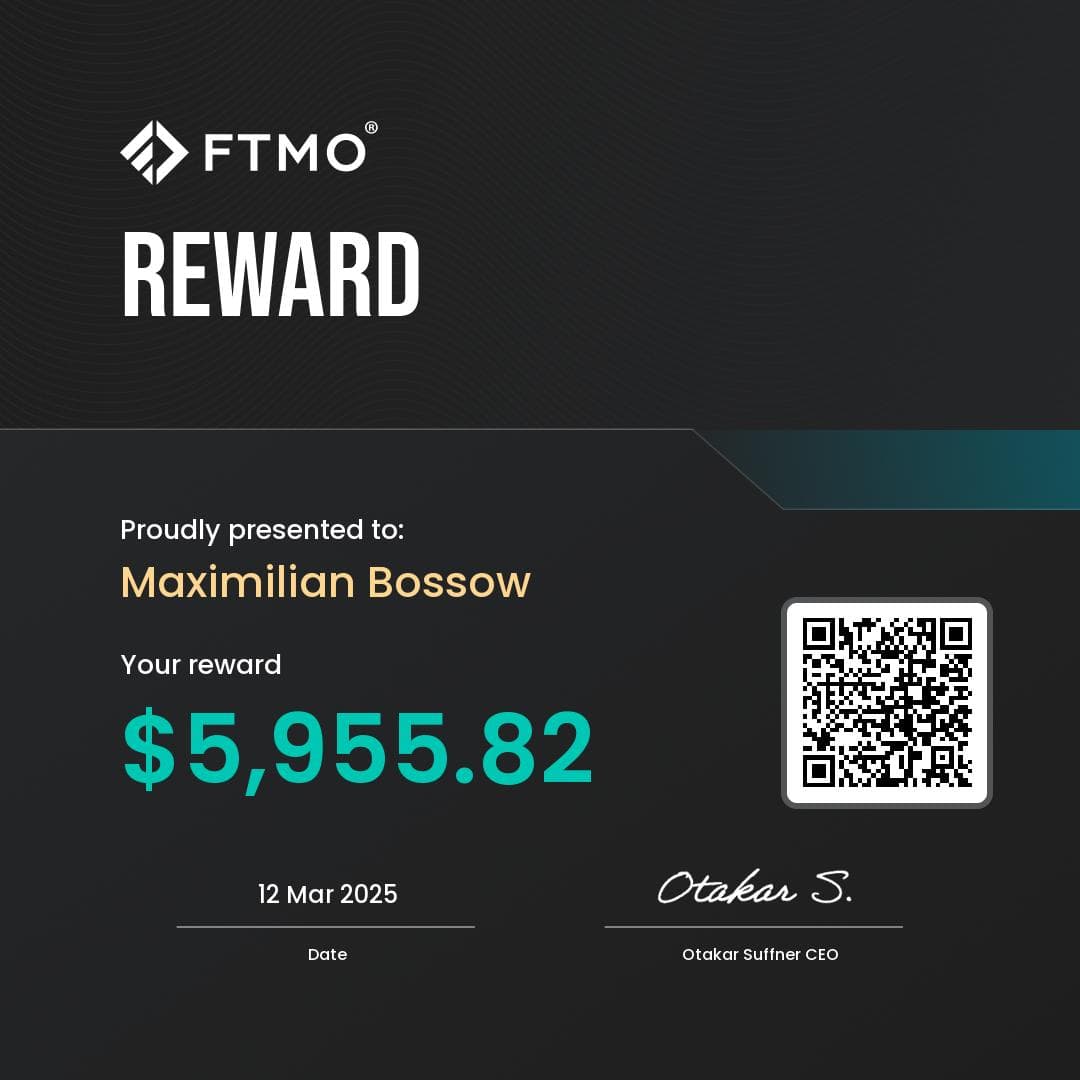
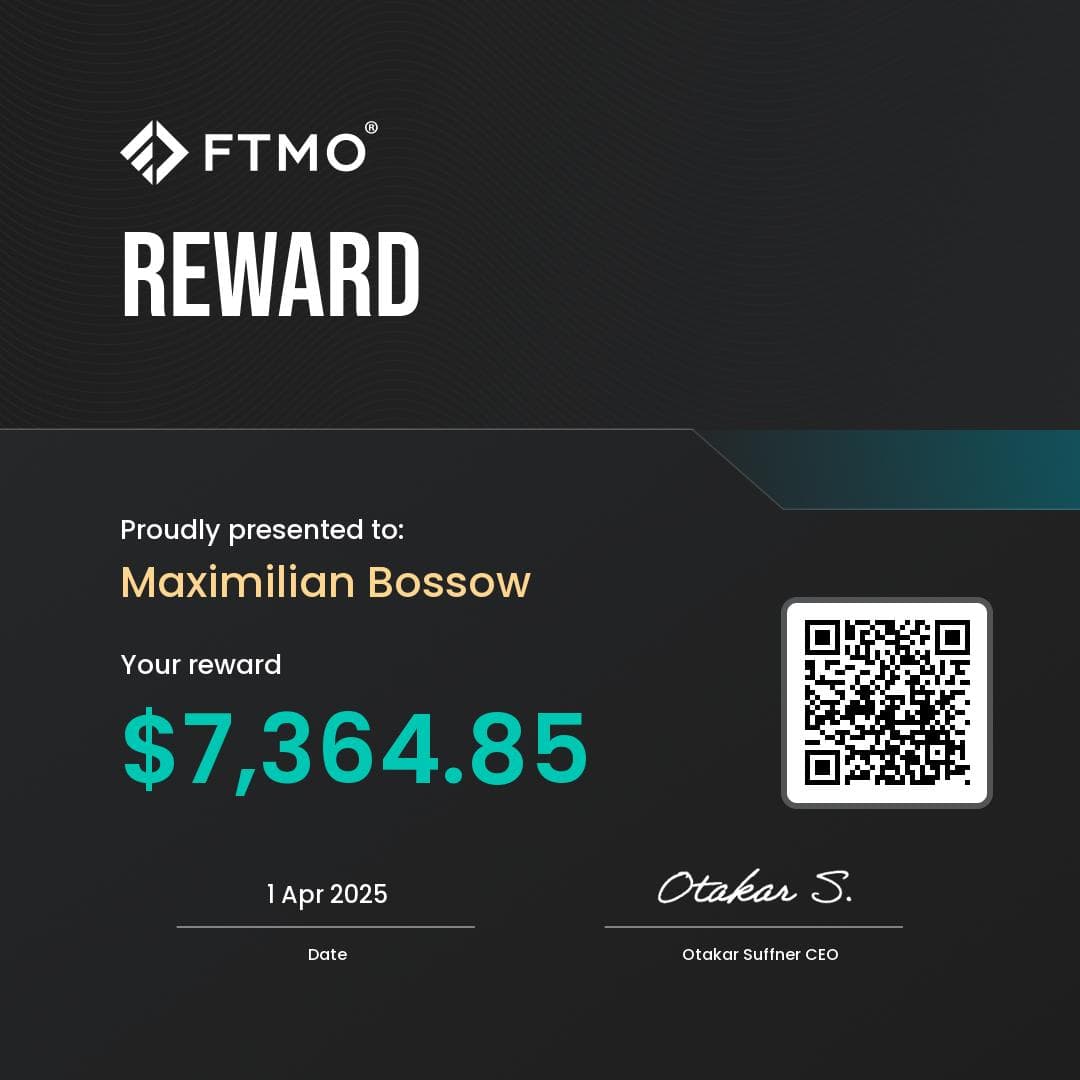
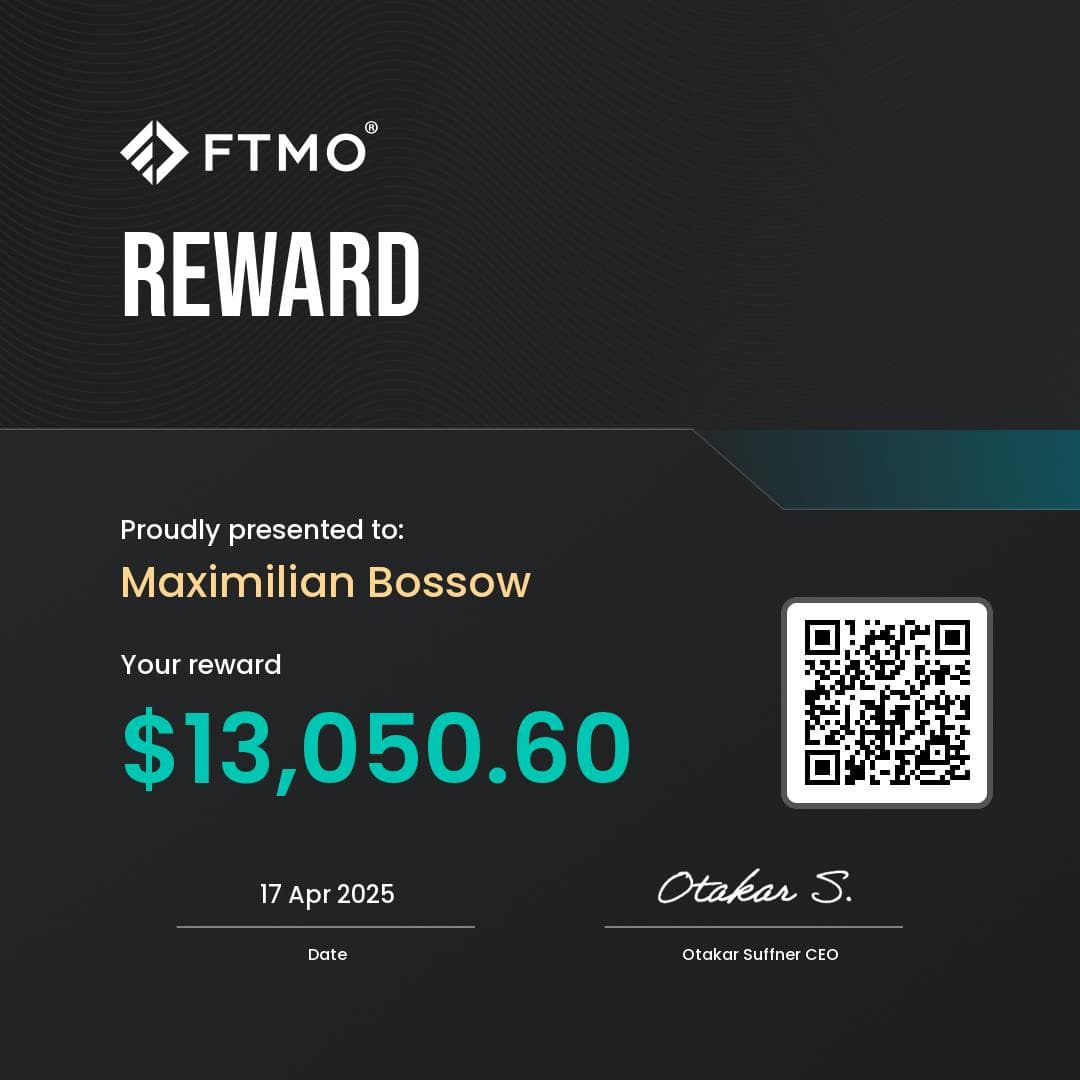
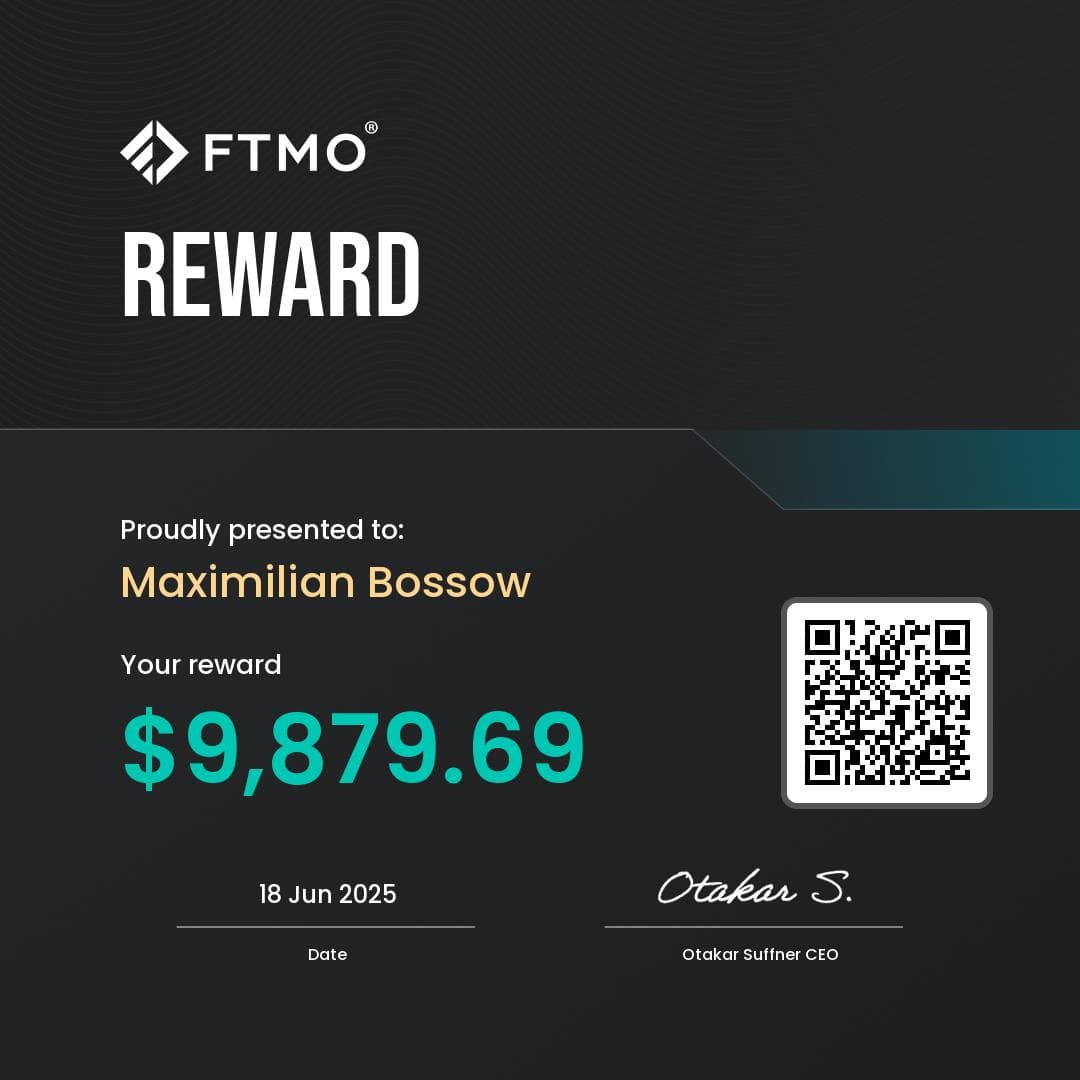
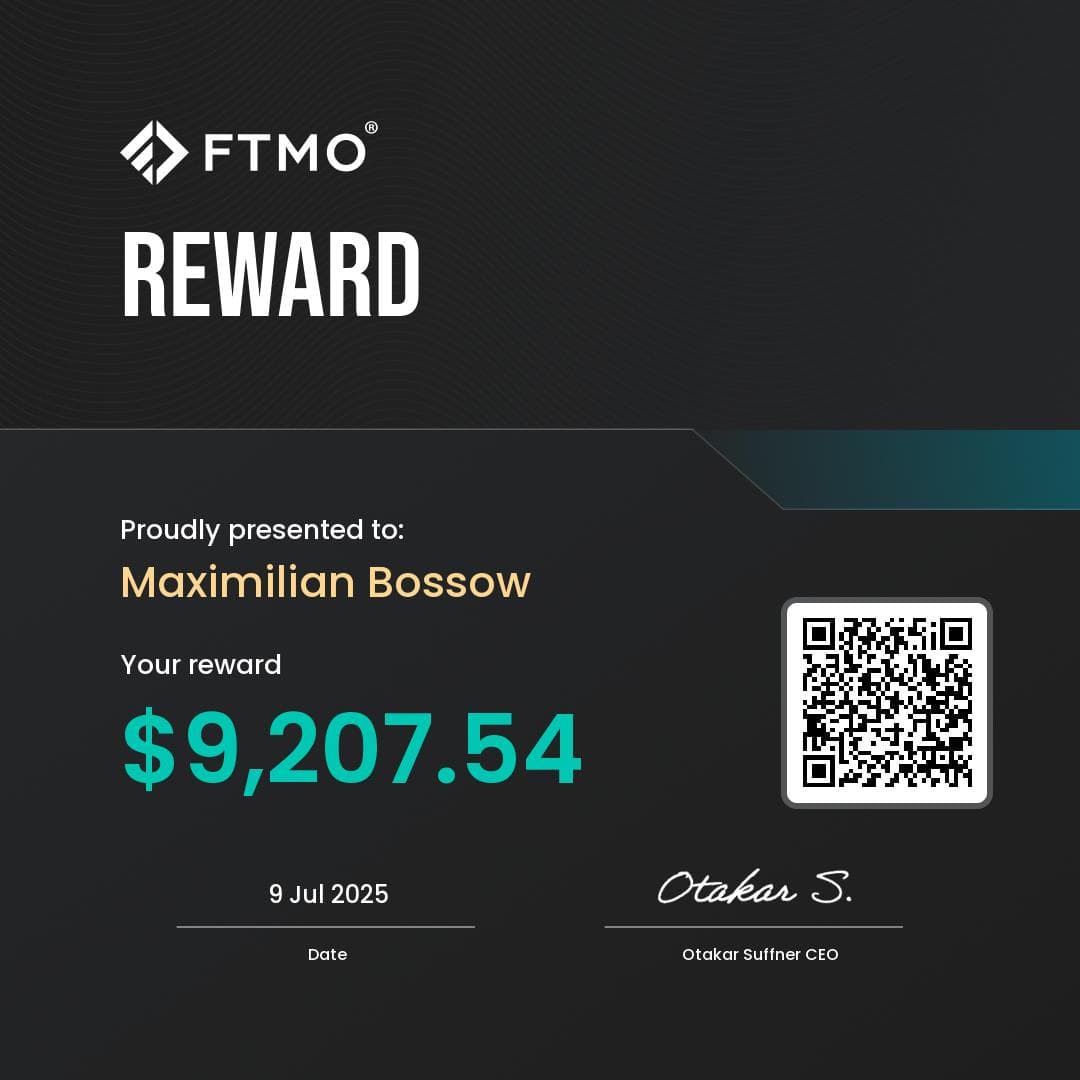
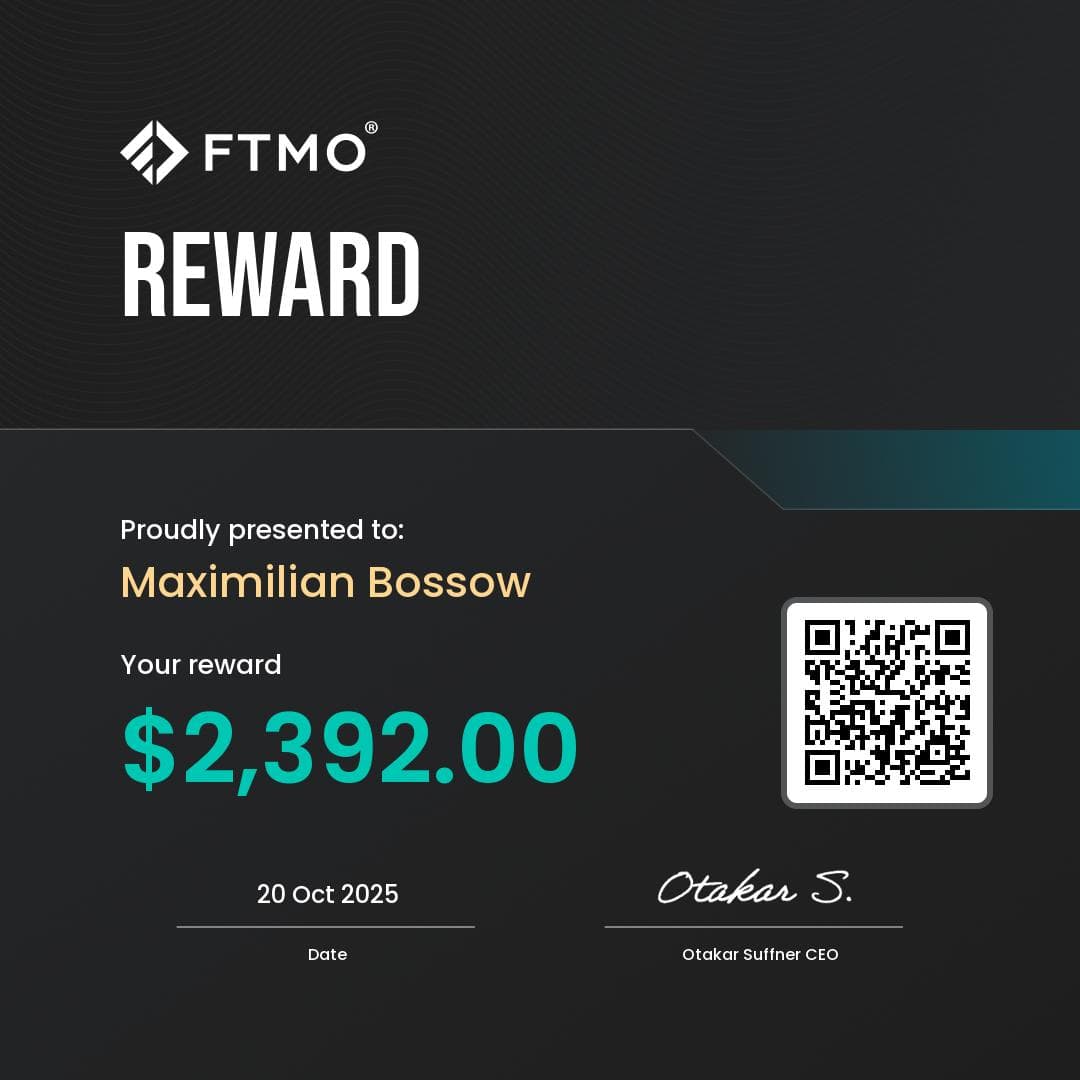
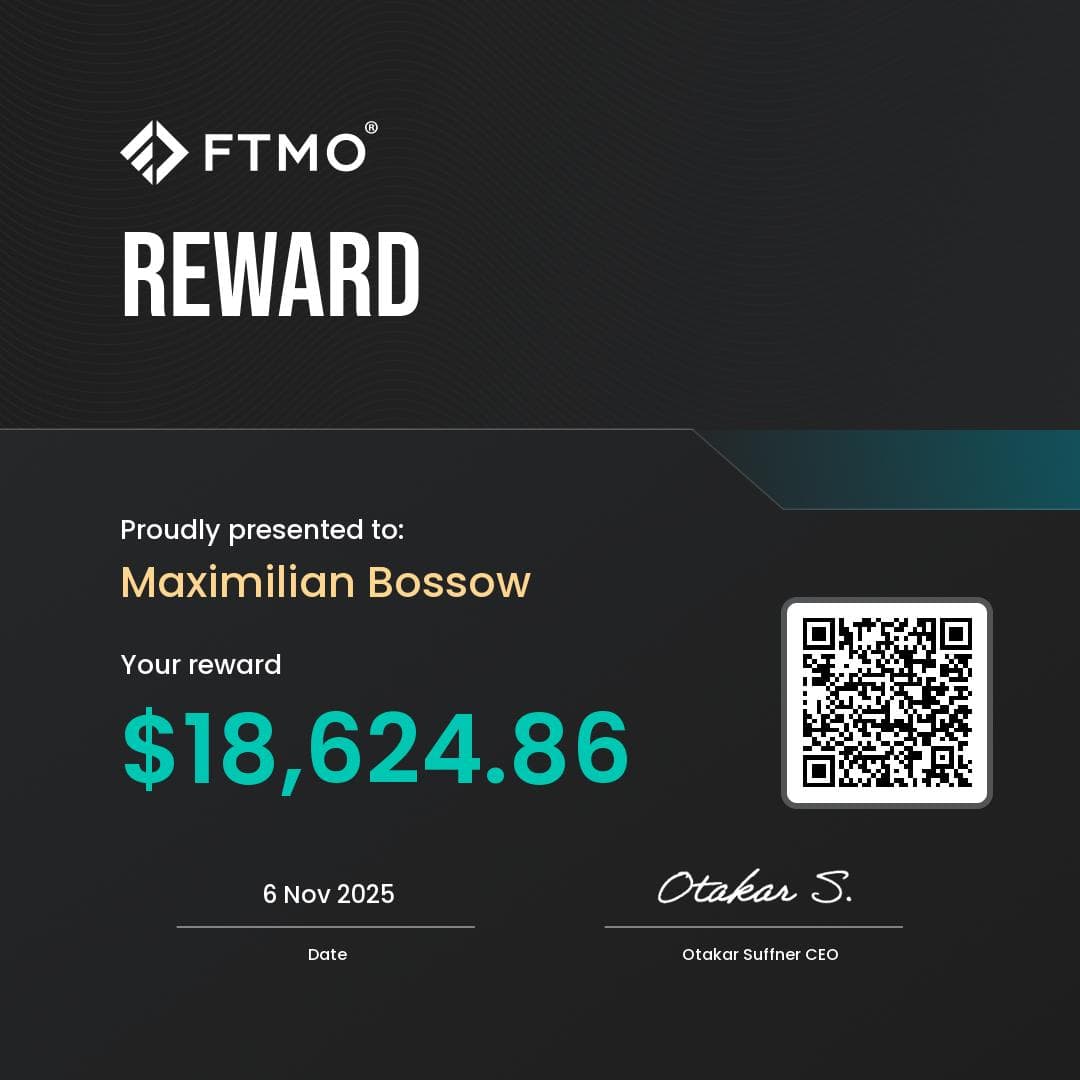
Most prop-firm marketing shows trading-account screenshots — easy to fake. FTMO issues these the day they wire money. Each one signed by their CEO, QR-verifiable, one per payout.
Click any receipt to inspect at full size

$100k+ in funded-account payouts. A pile of blown challenges before that. The system was the difference.
Started in 2020 with crypto at 19. Bought the top, sold the bottom, convinced myself I'd figured something out. Moved to CFDs by 2021 — prettier charts, cleaner commissions, same losses. Then went to YouTube. Bought a $3,000 course. Then an $800 one. Then a $200 one. Each promised the secret. None survived contact with my actual P&L.
Then I found prop firms. First Challenge: blew it — over-leveraged into news. Next: held a losing trade hoping it'd come back. Sunday gaps. Max-drawdown breaches. Daily-loss hits after some YouTuber told me “size up when you're up.” I lost count.
Free information isn't free. It's just paid in losses and years.
If you've ever held a losing trade hoping it'd come back, or sized up after a green day because someone told you “when you're up, press” — you already know the price.
It clicked on a flight home in November 2024. I'd just blown another challenge — the same execution mistake I'd repeated for the better part of a year. I opened my journal and wrote one sentence: Stop trying things. Start understanding why one thing works.
I treated my trading like a system to debug. Wrote down every rule I followed in winning weeks, every rule I broke in losing ones. The pattern was insulting in its simplicity.
I wasn't bad at trading. I was bad at following trading.
So I stopped collecting strategies and built one execution system. Three pillars, five rules each, a daily loop, a weekly review, a failure-protocol for when I broke a rule (because I would). The Compliance Loop. Three weeks in I broke one anyway — lost 4% on a felt setup. The protocol caught it. The next week was clean. Then I went deep on one prop firm: FTMO. The certificates above are real. So is the road it took.
If you're reading this, you've probably been where I was. Tabs open: YouTube, TradingView, the FTMO dashboard. The voice in your head: maybe I'm just not built for this.The math says there's nothing wrong with you that a real system can't fix. I built it because I was you.
FTMO Trader Dashboard · Billing. Every line is a real Paidchallenge fee — not a marketing claim. The badges are FTMO's own UI.
Most coaches hide what they spent before they figured it out. I lead with the receipts. The system exists because I paid this much for the education the hard way.
The exact rules live inside the Blueprint. What’s free is the shape — the three things every challenge I run is built on.
Pillar 01
Your max loss is decided before the chart opens. Even ten losses in a row can’t take you out — the math protects you on bad days.
Pillar 02
Most setups look fine but aren’t. You learn to grade them — and skip the ones that don’t clear the bar. Fewer trades, better trades.
Pillar 03
A daily warm-up, a weekly review, a fix-protocol when things slip. The same loop, repeated until the system runs on autopilot.

Trading bots don’t survive prop-firm rules.
Daily-drawdown caps and max-drawdown ceilings are too tight, too imprecise. A bot that runs on live capital won’t pass a challenge — the rule-set is built to flag exactly the patterns bots produce.

Stop searching for the perfect strategy on Instagram or YouTube.
Most of it is retail knowledge — frameworks repackaged for the algorithm, not for the prop-firm rule-set. Edge isn’t a hashtag away.

Psychology beats strategy. Every time.
The hard part isn’t finding the framework. It’s you — sticking to it under pressure, after a loss, during a drawdown. Without discipline, the best system on paper is worthless in practice.
Based on three FTMO Platinum-tier funded accounts. Not investment advice.
Built around the same playbook I use to run my own Platinum-tier challenges. No fluff stack — every piece earns its slot. Application-only — pricing walked through in the Discovery-Call.
01
Twelve modules, ~6 hours of structured content. The full system, walked through with real charts and live trade reviews. Yours forever.
02
Five 1-on-1 sessions to start — and as many more as you need until the system actually clicks for you. Direct call with me. Not group, not pre-recorded. Scheduled around your life.
03
Lifetime access. Daily trade-reviews, weekly group call, member-only system updates, library of past Q&A.
04
Four weekly group sessions where I walk through real setups in real time — yours and mine. The reps that turn the framework into intuition.
05
Every refinement to the system after you join. Rule changes, new failure-modes I document, new patterns. You get them automatically.
Format
Application
Support
Until it clicks
Access
Lifetime
Calls
5 × 1-on-1
Support — until it clicks
The 1-on-1 calls keep going past the standard five if you've done the work and the system hasn't clicked yet. The risk lives on me, not you.
Extended — 6 months
If you do the work and still haven't passed a Challenge in 6 months — 5 more 1-on-1 calls, free. The calls don't stop until it clicks.
90 seconds · No email required · Pricing in the call
Got a question first? Ask me on WhatsApp →
Not ready for 1-on-1 coaching yet? Get the Risk-of-Ruin Mini-Course →
Each certificate below is a real profit-split payout pulled from one of my own FTMO funded accounts. Not a passing-cert. Money out. Same playbook is what you’ll learn.
Same path. 90-second application. Pricing in the call.
We accept 25 students per cohort. Once spots fill, pricing flips permanently. Application-only — we confirm fit on a 20-min call before walking through pricing together.
The 1-on-1 calls aren't batched. They're scheduled around your life and adapted to your specific prop-firm rule-set. Here's the rough cadence — yours will vary.
Day 1
Welcome-pack + Skool-invite + WhatsApp-intro from me. Your 1-on-1 calendar opens — book your first session within the week.
Week 1
Risk-of-ruin math + account-floor rule. First 1-on-1 covers your specific risk-profile and which prop-firm rule-set we calibrate against.
Week 4
Modules 1–4 done, second 1-on-1 reviews your last 10 paper-trades. Green-light to start your first Challenge with the Compliance Loop in place.
Month 3
Most students close their first Challenge within 60–90 days. The remaining 1-on-1s cover Phase-2 transition and Funded-Account scaling. Calls keep going past five until the system clicks.
I read every message myself. If you're on the fence, ask. Happy to do a 15-min Zoom or WhatsApp call before you buy — no script, no pitch, just questions.